Thursday, April 27, 2006

Connecting Places


Some places you go... you always meet someone you know. And even better, someone you should know, but don't yet!

These places are magnetic because people know they will meet "birds of feather" there -- people with overlapping interests, but with diverse networks. ACEnet's kitchen incubator is one such place. It mixes and matches people from SE Ohio who are involved, or want to be, in the local food industry.

Another connecting place is the Chicago Mosaic School. On a Sunday afternoon, local mosaic artists stop in to work on their projects, chat, gossip, see what's new, and help each other out. There they mix with artists from other cities who are in town taking classes at the school -- combining similar interests, different networks.

The Executive Director of the School, Karen Ami, is a natural network weaver. She connects mosaic artists and clients both nationally and internationally. People are attracted to Karen for her knowledge and expertise, and also for her ability to connect you to the right other person. Natural network weavers are like that... they attract people, lots of people, who wish to be connected.

Sunday, April 23, 2006

Regional Networks


We are seeing more and more interest in "regional economies" all over the world. One of the key players in regional economics are the mayors of the cities in that region. How are the mayors in your region connected? Are they exchanging ideas? Are they assisting each other? Or are they chasing smokestacks and high tech labs, and only competing with each other?

Above is a network map of mayors from a small country in the European Union. The population of this country is around 5 million, about the size of typical economic region. The nodes, representing each mayor, are colored by political party.

Two things are immediately apparent:
1) This is a well connected network -- no isolates, no fragments, no bottlenecks. Measuring the network, we find a short average path length -- very little delay and distortion in communication flows.
2) There is no political polarization, as currently found in the U.S. -- various colors link to various other colors.

Because of the cross-polination of knowledge and ideas, along efficient communication paths, I am betting that these mayors give their region a strong advantage.

Network Mapping


The first step in Network Weaving is mapping the existing networks in your organization/community/region.

• What are our strengths?
• What are our weaknesses?
• Where are the disconnects?
• Who are the Connectors?
• Who are the Mavens?
• Who is in the clusters?
• How open/closed is our network?
• How have we progressed since last year?

Just like doctors use x-rays and CAT scans to see, and make sense of, what is happening in the complex human organism, we use network x-rays to map and measure what is happening in complex human communities like organizations, industries and regional economies.

Entrepreneurs 4 Sustainability


E4S, one of the premier entrepreneurial learning communities in Ohio [if not nationally!], held their annual network building meeting at the Great Lakes Brewing Company this week. A diverse group of attendees -- suits to sandals -- heard great bootstrap stories, did speed-networking led by Grant Marquit, and heard June and Valdis talk about network weaving in other places. During the meeting, Holly Harlan -- founder of E4S, publicly closed some triangles. She introduced several people to each other, pointing out why introduction will be fruitful -- she is working at the top levels of Jack's Introduction Pyramid. Wonderful modeling, Holly!


Two E4S members examine how the dots are connected [and could be connected] on the entrepreneurial network maps...

Network Weaving in West Africa

Next week I'll be flying to Ghana to work on a United Nations project. They will be bringing together non-profit and government leaders from 15 West African countries to learn how to weave network and work together.

Tuesday, January 31, 2006

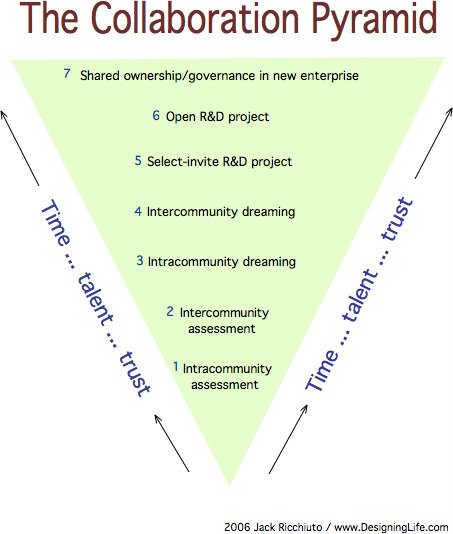
The Collaboration Pyramid


1 / Intracommunity assessment
People within communities work together to create a common understanding of the opportunity landscapes. We’re talking here about 5 types of communities:

a. people with needs/hopes
b. people with new ideas
c. people with talent/expertise
d. people with resources/funding
e. people with social/political/economic legitimizing power

At Level 1, people with needs and hopes work together with other people with needs and hopes; people with new ideas work together with other people with new ideas, and so on. All collaborations happen within each community.

2 / Intercommunity assessment
People across communities work together to create a common understanding of the opportunity landscapes. For example at Level 2, you find collaborations between people with needs/hopes working with people with new ideas. People with funding/resources working with people with talent/

3 / Intracommunity dreaming
People within communities collaborate in visioning, prioritizing, and planning relative to discovered collaboration opportunities.
expertise.

4 / Intercommunity dreaming
People across communities collaborate in visioning, prioritizing, and planning relative to discovered collaboration opportunities.

5 / Select-invite R&D project
People within or across communities work together in invitation-specific projects

6 / Open R&D project
People within or across communities work together in open invitation projects

7 / Shared ownership/governance of new enterprise
Participants of R&D projects that create a new enterprise share ownership and/or governance. New enterprises include new civic programs, organizations, services.

Sunday, January 29, 2006

Our 3 circles


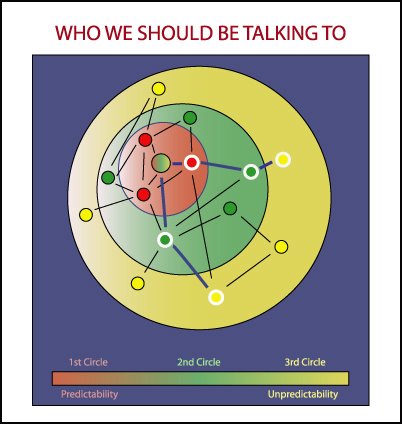
This is a graphic we use to show our 3 circles of connections in our networks.

Our 1st circle are people we know well.
In our 2nd circle are people we know but not well - they are our 1st circle people's 1st circle
In our 3rd circle are people we don't know at all, but who are known by people in our 1st and 2nd circles.

The further out we go, the more we discover people with more differences than ourselves, which in our world, means a goldmine of new possibilities!

Saturday, January 28, 2006

The Planet: One introduction at a time


Networks build through introductions and not all introductions are equal. They are distinguished by the quality of the introduction.

If people are not naturally connection-prone, we need to spend more time facilitating connection. The more we are a presence in the introduction, the more people gain from the trust each has with us.

Introductions are an art yet conceptually simple: it's all about helping people discover the value in each other.

How do social and economic networks the size of a planet grow? As Valdis says: one introduction at a time.

Building Smart Networks

The Network Weaving experience of ACEnet is described in a white paper [PDF] by Valdis and June. The paper steps you through the network weaving process, from beginning to vibrant network. The paper was published in the Non-Profit Quarterly in 2005 and was chosen as one of the best articles of the year in NPQ.

In the latest version of the paper, we add a new idea from Jack -- the Introduction Pyramid [PDF]. This explains how one-on-one introductions are a key part of weaving the network and how they follow a scale of involvement and probablity of success.